

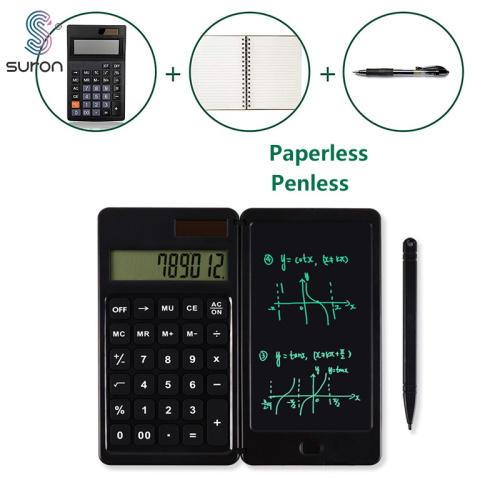
In the 1950s, the development of electronic technology gave rise to the emergence of electronic calculators. These calculators use electronic components instead of mechanical parts, allowing for greater accuracy and speed. In 1957, the first commercial electronic calculator appeared, manufactured by the American company Monroe, which was able to perform basic operations such as four arithmetic operations and square roots.
With the advancement of semiconductor technology, the size of calculators has gradually shrunk and their functions have gradually increased. In 1967, Texas Instruments introduced the first handheld electronic calculator, called the Cal Tech. Although it could only perform basic arithmetic operations, its portability changed the way people used calculators.
In 1972, HP launched the world's first scientific calculator, model HP-35. HP-35 has scientific calculation functions such as trigonometric functions, logarithms, and exponentials, and became an essential tool for scientists and engineers at that time. Its success prompted other companies to launch scientific calculators with similar functions, promoting the rapid development of the scientific calculator market.
In the 1980s, with the maturity of microprocessor technology, the functions of scientific calculators were further expanded. New scientific calculators are capable of performing complex mathematical and statistical operations, have greater storage capacity, and are more user-friendly. In addition, they also incorporate graphic display functions that allow users to visually view the graphics of mathematical functions.
At the beginning of the 21st century, with the popularity of smartphones and tablets, scientific calculators gradually evolved into the form of mobile applications. Many mobile applications offer advanced scientific calculator functionality that even exceeds that of traditional hardware calculators. This trend has made scientific calculators more portable and flexible, making them ideal for people to perform mathematical and scientific calculations anytime and anywhere.
In general, scientific calculators have evolved from mechanical to electronic, and from desktop to portable. Its development has been driven by electronic technology, semiconductor technology and microprocessor technology, providing convenient, accurate and efficient tools for people's mathematical and scientific calculations. With the continuous advancement of technology, scientific calculators will continue to develop to provide more powerful support for human scientific research and engineering practice.